Rumania’s grip on Bessarabia / О румынском захвате Бессарабии

Представляем вашему вниманию перевод на русский новозеландской статьи о (цитирую) “Румынском захвате Бессарабии” 1918-го года.
Оригинал в полном объеме представлен ниже. Bellow is presented the artice of the “The Evening Star” newspaper of Dunedin (New Zealand) published on April 15, 1924.
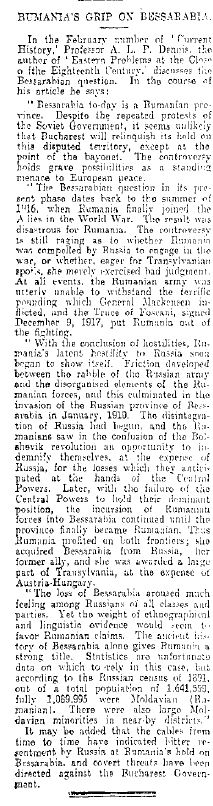
РУМЫНСКИЙ ЗАХВАТ БЕССАРАБИИ
—
В февральском номере журнала “Современная история” профессор А. Л. П. Деннис, автор книги “Восточные проблемы на рубеже XVIII в.”, обсуждает Бессарабский вопрос. В своей статье он говорит:
“Бессарабия в наши дни - это румынская провинция. Несмотря на неоднократные протесты советского правительства, кажется маловероятным, что Бухарест откажется от владения этой спорной территорией, кроме как штыком. Спор создает серьезные опасения для европейского мира.
“Бессарабский вопрос в его нынешней фазе восходит к лету 1916 года, когда Румыния, наконец, присоединилась к союзникам во Второй мировой войне. Результат был катастрофическим для Румынии. По-прежнему бушуют споры о том, принуждала ли Румынию к войне Россия, или же, стремясь к трансильванским трофеям, она просто совершала нечестный поступок. Во всяком случае, румынская армия была совершенно неспособна выдержать тот страшный удар, который нанес генерал Маккенсен, и Фосканское перемирие, подписанное 9 декабря 1917 года, вывело Румынию из боя.
“С окончанием военных действий скрытая враждебность Румынии к России вскоре начала проявляться. Трения развивались между сбродом русской армии и дезорганизованными элементами румынских войск, и это завершилось вторжением русской провинции Бессарабии в январе 1918 года. Начинался распад Русской империи, и румыны увидели в замешательстве большевистской революции возможность возместить себе за счет России те потери, которые они ожидали от Центральных Держав. Позднее, когда Центральные Державы не смогли удержать свое господствующее положение, вторжение румынских войск в Бессарабию продолжалось до тех пор, пока губерния, наконец, не стала румынской. Таким образом, Румыния нажилась на обеих границах; она овладела Бессарабией от России, своего бывшего союзника, и выиграла большую часть Трансильвании, за счет Австро-Венгрии.
“Потеря Бессарабии вызвала у русских много откликов среди всех классов и партий. Однако совокупность этнографических и лингвистических свидетельств, похоже, способствовала румынским притязаниям. Одна только бессарабская история дает Румынии сильное преимущество. Статистические данные в этом случае неутешительны, но согласно русской переписи 1891 г. из общей численности населения 1 641 599 человек, полностью 1 089 995 были молдаване (румыны). В близлежащих районах также проживали крупные молдавские меньшинства”.
Можно добавить, что по кабелям время от времени высказывалось горькое негодование со стороны России, что Румыния захватила Бессарабию, и скрытые угрозы направлялись против правительства Бухареста.
====== “Вечерняя звезда” № 18610; Дунедин (Новая Зеландия), 15 апреля 1924 г.
— ORIGINAL —
THE MAKING OF TREATIES
—-
FRANCE ACTIVE
–
LINKING UP WITH LITTLE ENTENTE
–
Press Association - By Telegraph-Copyright
–
LONDON, April 13th
The Paris correspondent of The Times says that it is now regarded as certain that a Franco-Romanian defensive Treaty will be the outcome of the negotiations which are at present proceeding in Paris between M. Pointcare and M. Duca, the Rumanian Foreign Minister. It is believed that the compact will follow the lines of the recent Franco-Czech treaty, but it will be closely guarded until the signatures are attached.
The conclusion of such a treaty is generally welcomed as tanding to strengthen the position of the Little Entente, but M. Poincare is urged to go warily, particularly in view of the present Russo-Romanian conflict over Bessarabia. The newspaper ‘Quotidien,’ for instance, says that while it approved the Czecho-Slovakian treaty it must make a reservation regarding a treaty with Rumania. The paper emphasizes the fact that Czecho-Slovakia it’s a profoundly peaceful democracy while Rumania remains governed by cliques succeeding each other without the slightest change in programme. It asks what the position of France would be in the event of open war between Moscow and Bucharest. - The Times.
PARIS, April 14
There is a general belief that the three days visit of the King and Queen of Rumania will result in an alliance between France and Rumania. This will round off the alliances between Rumania, Czecho-Slovakia and Jugo-Slavia against Hungary, and Rumania and Poland against Russia.
M. Trotsky has already threatened Rumania with war unless she relinquishes her Bessarabian rights under the treaties with the Allies.
M. Tchitcherin has telegraphed to M. Poincare denouncing France’s ratification of Rumania’s seizure of Bessarabia. A. and N.Z. Cable.
[Rumania’s territories has greatly increases as a result of the war, and the ante bellum area of the kingdom (53.000 square miles) was more than doubled by the inclusion with its borders of Bessarabia, Transilvanya, Bukowina, and part of the Banat of Temesvar. The area of the enlarged kingdom of Rumania may thus be estimated at 122,282 square miles and the 1914 population of 7,000,000 million has been increased to 17,000,000.]
RUMANIA’S GRIP ON BESSARABIA — In the February number of “Current History,” Professor A. L. P. Dennis, the author of ‘Eastern Problems at the Close of de Eighteenth Century.” discusses the Besarabian question. In the course of his article he says: “Bessarabia to-day is a Rumanian province. Despite the repeated protests of the Soviet Government, it seems unlikely that Bucharest will relinquish its hold on this disputed territory, except at the point of the bayonet. The controversy holds grave possibilities as a standing menace to European peace. “The Bessarabian question in its present phase dates back to the summer of 1916, when Rumania finally joined the Allies in the World War. The result was disastrous for Rumania. The controversy is still raging as to whether Rumania was compelled by Russia to engage in the war, or whether, eager for Transylvanian spoils, she merely exercised bad judgment. At all events, the Rumanian army was utterly unable to withstand the terrific pounding which General Mackensen inflicted, and the Truce of Foscani, signed December 9, 1917, put Rumenia out of the fighting. “With the conclusion of hostilities, Rumania’s latent hostility to Russia soon began to show itself. Friction developed between the rabble of the Russian army and the disorganised elements of the Rumanian forces, and this culminated in the invasion of the Russian province of Bessarabia in January, 1919. The disintegration of Russia had begun, and the Rumanians saw in the confusion of the Bolshevik revolution an opportunity to indemnity themselves, at the expense of Russia, for the losses which they anticipated at the hands of the Central Powers. Later, with the failure of the Central Powers to hold their dominant position, the incursion of Rumanian forces into Bessarabia continued until the province finally became Rumanian. Thus Rumania profited on both frontiers; she acquired Bessarabia from Russia, her former ally, and she was awarded a large part of Transylvania, at the expense of Austria-Hungary. “The loss of Bessarabia aroused much feeling among Russian of all classes and parties. Yet the weight of ethnographical and linguistic evidence would seem to favor Rumanian claims. The ancient history of Bessarabia alone gives Rumania a strong title. Statistics are unfortunate data on which to rely in this case, but according to the Russian census of 1891. out of a total population of 1,641,599, fully 1,089.995 were Moldavian (Rumanian). There were also large Moldavian minorities in nearby districts.” It may be added that the cables from time to time have indicated bitter resentment by Russia at Rumania’s hold on Bessarabia, and covert threats have been directed against the Bucharest Government.
====== “The Evening Star” No. 18610; Dunedin (New Zealand), April 15, 1924